Introduction
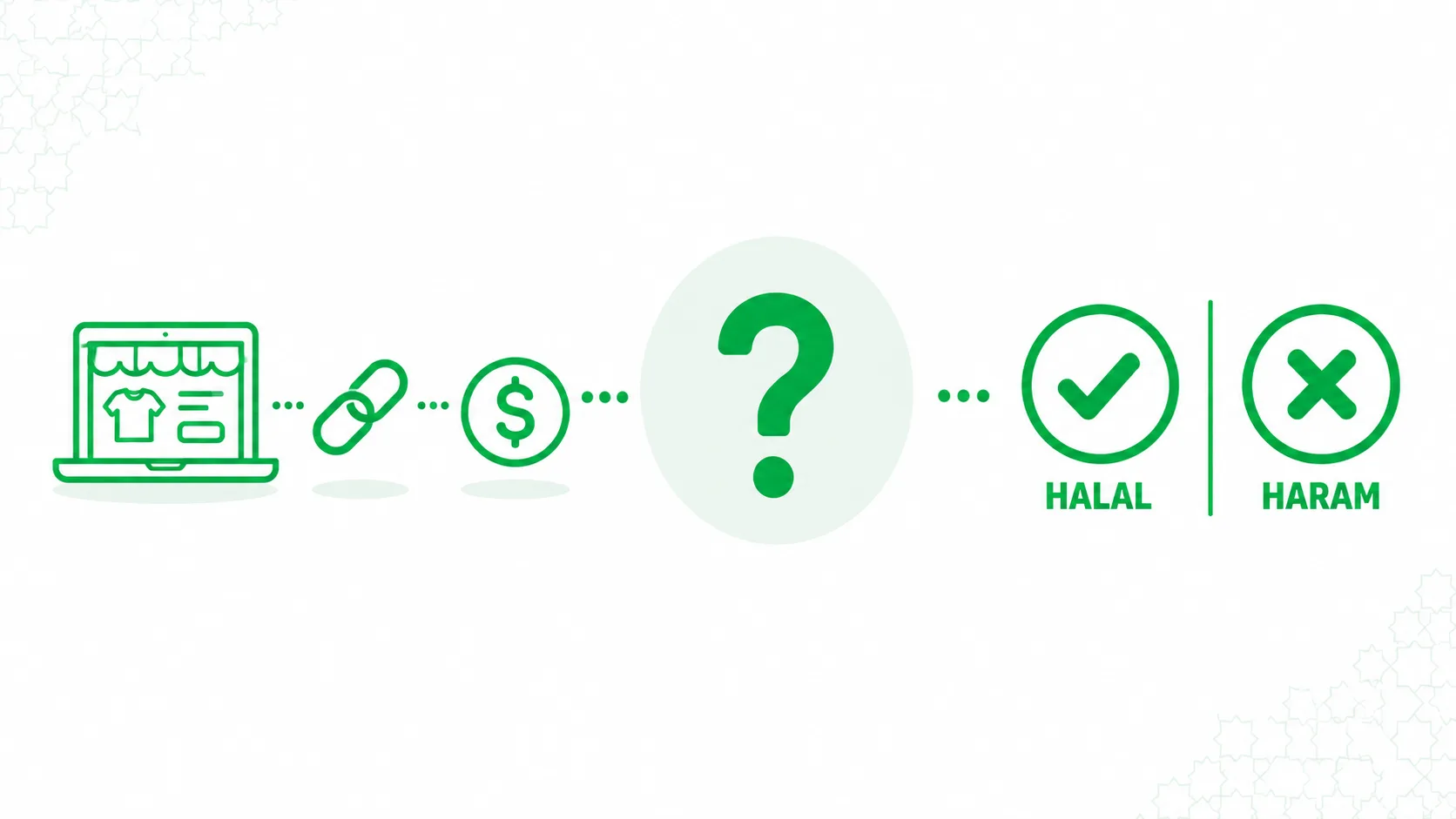
In the modern digital economy, affiliate marketing has become a common way for people to earn income online by promoting other companies’ products in exchange for a share of sales. Technically, affiliate marketing is “an advertising model where a company compensates third-party publishers to generate traffic or leads to the company’s products and services”. Affiliates place links or ads on websites, blogs, or social media. When a visitor follows the link and makes a purchase, the affiliate earns a commission. This internet-based model has expanded rapidly with globalization and technology, reaching billions of consumers worldwide.
As more Muslims participate in e-commerce, affiliate marketing needs to be assessed through Shariah principles. Islamic law balances ease (taysīr) in trade with caution (waraʾ) against sin. The foundational legal maxim applies: “All things are permissible by default until proven otherwise” (al-aṣl fī al-ashyā’ al-ibāḥah). In other words, affiliate marketing has no inherent prohibition in the classical texts, so its default status is halal unless a specific rule makes it impermissible. At the same time, the Qur’an commands Muslims to cooperate “in righteousness and piety, but not in sin and aggression”. This means every business activity, including affiliate work, must support lawful ends and avoid haram products or deception.
Classical jurisprudence did not discuss online affiliate links directly, but scholars did recognize similar mechanisms of agency and brokerage, such as wakālah, jāʿalah, and simsāra. These provide useful precedents. The task, then, is to apply these foundational principles and examine affiliate marketing under the four Sunni schools of law: Hanafi, Maliki, Shafi‘i, and Hanbali, along with contemporary fatwas.

Defining the Subject: Modern Context vs. Classical Fiqh Principles
Affiliate marketing is essentially a modern marketing and commission system. Under this model, a merchant, such as an e-commerce platform like Amazon, Shopee, or Airbnb, registers affiliates to promote its products. When a consumer clicks an affiliate’s unique link and buys a product, sometimes any product on the site, the affiliate receives an agreed-upon commission. In practical terms, affiliates do not manufacture goods or own inventory. They provide marketing services through digital content such as reviews, ads, social media posts, and product comparisons to direct customers to the vendor. The buyer deals directly with the merchant at the point of sale, and the commission is later paid through the affiliate program. In modern terms, affiliate marketing is often pay-per-sale or pay-per-click advertising. Affiliates are rewarded for increasing sales volume by earning a percentage of each sale.
From a classical fiqh perspective, affiliate marketing is not a fundamentally new contract. It is better understood as a modern application of agency or brokerage. The affiliate acts as an agent (wakīl) or advertising broker for the vendor. In Hanafi terms, this resembles a jāʿalah commission contract or a wakālah with ujrah, meaning agency for a fee. In Shafi‘i and Hanbali usage, it resembles wakālah or simsāra (brokerage). In Maliki law as well, it may be treated as the appointment of an agent with agreed compensation.
Classical texts state that if a person makes an effort on behalf of another to bring about a sale, he is entitled to customary wages or a commission for that effort. One fatwa explains that “if a person made effort and spent time in selling another individual’s item and succeeded in getting it sold, it is permissible for him to take customary wages and commission for the effort expended”. Islamic finance also recognizes paid agency as valid. The Qur’an narrates the sending of an agent to buy on one’s behalf, and the Prophet ﷺ appointed agents for purchasing, which clearly supports the permissibility of agency and remuneration for it. In short, from a modern perspective affiliate marketing is allowed by default, and from a classical fiqh perspective it falls under the principle that work involving real effort may earn a wage (ujrah).
Islamic jurists have also addressed closely related scenarios. For example, Islamweb addressed electronic marketing by commission and ruled: “If marketing is for something permissible, then there is no harm in it, and one may take a commission for it; it makes no difference whether it is electronic or not, because marketing is a service…for which one may take compensation, provided that the marketed goods are lawful”. In other words, if the products or services being promoted are halal, online affiliate marketing is acceptable. The use of the internet does not change the ruling.
Likewise, a detailed Hanafi fatwa on Amazon affiliates concluded that advertising a permissible product “without lying, deception, etc.” and taking the agreed commission is “permissible…whether the product purchased is the one you advertised or another one”. This shows that classical principles can comfortably accommodate affiliate programs as legitimate marketing services.
Applying al-asl fi al-ashyā’ al-ibāḥah (the presumption of permissibility), affiliate marketing begins as a permissible trade-service arrangement involving lawful goods. No classical text explicitly forbids “commission sales” or “advertising for pay.” In fact, jurists recognized such work as an established practice. Therefore, the starting point is that affiliate marketing is halal by default. It becomes impermissible only when it includes haram elements, such as promoting forbidden products, fraud, deception, or harmful practices.
The Core Jurisprudential Mechanisms and Scholarly Debate
Legally, affiliate marketing primarily involves agency (wakālah) and brokerage (simsāra or jāʿala) contracts. These mechanisms are well established in Islamic law. Under a wakālah contract, a principal authorizes an agent to act on his behalf. The agent may receive a fee (ujrah) for the service. Under a jāʿalah contract, a person promises a reward to whoever completes a specified task, such as selling a product or bringing a buyer. In affiliate marketing, the affiliate is contracted by the merchant either as an agent who advertises for a set percentage or as a rewarded party paid per successful referral. All four Sunni schools recognize these contracts as valid when their conditions are met.
The madhhabs frame the contract in slightly different ways, but none of them prohibit it outright. Hanafi jurists, for example, permit an agent to take an ujrat al-mithl (customary wage) or an agreed share for sales work. A Hanafi scholar quotes from Radd al-Muhtar: if someone expends effort on behalf of a seller, he earns a wage proportionate to that effort. In the case of an affiliate, even if the buyer purchases a different item from the one originally advertised, such as on a large marketplace, the Hanafi view explained by Darulifta is that the affiliate still deserves the commission because the sale of the seller’s goods was facilitated by the affiliate’s marketing. The reasoning is clear: the affiliate’s link brought the customer to the site, making the sale possible. Therefore, the platform’s contract obligates it to pay commission on any resulting purchase. This reflects the Hanafi emphasis on the agent’s entitlement for effort under an ijārah or jāʿalah contract.
Shafi‘i and Hanbali jurists would also allow paid agency, provided the terms are explicit. In Shafi‘i fiqh, an agent (wakīl) may stipulate a specific fee or percentage, and brokers (simsārs) earn their brokerage when they complete a sale without deception. There is no established opinion declaring affiliate-like marketing intrinsically forbidden. Maliki jurists also permit agency and brokerage as long as the service is beneficial and honest. They place strong emphasis on preventing exploitation of the buyer.
For example, the Najah University fatwa, a contemporary authority, states that e-marketing is a service that benefits others and “it is permissible to be compensated in money for it because it enters the category of brokerage/dalālah,” provided certain conditions are met, including halal goods and truthfulness.
The broad Sunni position, therefore, is that selling or marketing on commission is lawful. The schools do not treat the commission contract itself as the problem. The real debate concerns its limits and conditions. All agree that the marketed goods or services must be lawful. They also require clarity in the agreement: the amount or percentage of commission should be known, whether fixed or based on a clear formula, and the conditions for payment should be agreed upon in advance. Classical jurists warned against excessive uncertainty (gharar), but this concern mainly applies to the sale contract itself, such as selling something unknown or undeliverable. In affiliate marketing, the contract is for marketing effort rather than the direct sale transaction, so gharar is limited if the affiliate’s duties and reward are clear.
For these reasons, there is no fundamental conflict between affiliate marketing and Shariah principles. Each school’s analysis reaches a similar conclusion: affiliates act as hired promoters and may be justly paid. The main concerns arise in surrounding issues, such as advertising ethics, the permissibility of products, and transparency, rather than in the commission contract itself. As one contemporary fatwa states: “Working on commission is permissible… and therefore affiliate marketing is permissible provided [certain conditions].”. This reflects the wider juristic position that paid agency is generally allowed when the Shariah conditions of lawful subject matter, honesty, and clarity are fulfilled.
Conditions, Variations, and Modern Applications
Although affiliate marketing is generally permissible, specific conditions must be met for it to remain halal. Islamic law places safeguards around trade to prevent deception, harm, and cooperation in sin. Scholars and fatwas commonly emphasize the following conditions and variations:
- Halal Products/Services: The affiliate must promote only items that are permissible in Islam. “This implies that as an affiliate marketer, you are essentially an advertiser. Unless you are marketing haram products or services (such as alcohol, gambling, or forex). The income generated will be deemed as haram” if the affiliate promotes forbidden goods. In short, affiliate income is lawful only if the advertised products are halal. For food, cosmetics, or similar items, one should verify ingredients or seek scholarly advice if there is doubt.
- Transparent Commission and Fair Pricing: The commission arrangement should be clear and should not be hidden in a way that harms the buyer. According to Najah University’s fatwa, one condition is that “the commission [is] not added to the price of the commodity to the harm of the buyer”. In practice, this means the affiliate program should not secretly inflate prices to cover its fees. Most affiliate programs pay the affiliate from the company’s profit margin without raising the consumer’s price. The affiliate should still ensure that no deceptive markup or hidden charge is involved.
- Honesty and No Deception: Advertisements must be truthful. The affiliate must represent products honestly, without false claims or the concealment of material facts. Islam forbids deception in trade. The Najah fatwa explicitly requires the marketer to be “ṣādīqan fī mā yukhbiru bihi ʿan ṣifat al-salāʿah, ghāshiyan walā mukhādiʿan” (truthful and not betraying or cheating). Similarly, fatwa.ca states that “the promotion of the product and any claims or reviews about it must be honest”. This follows the prophetic guidance that traders must not lie or mislead buyers about goods.
- Modesty and Content: Marketing content should avoid immodest or indecent imagery. For example, fatwa.ca notes that affiliates should practice modesty, including not using pictures of women without proper Islamic standards in promotions. If an affiliate’s landing page or video automatically opens with music or images of women, the affiliate should consider this and inform viewers of it. In short, affiliate content should comply with Islamic norms of modesty and avoid nudity, lustful imagery, or indecent presentation.
- Avoiding Cooperation in Sin: The principle of not assisting others in sin is central. An affiliate must make sure that their marketing does not facilitate haram. One should not advertise interest-based loans, gambling, illegal schemes, alcohol, or anything essentially forbidden. Even indirect association requires caution. For example, if an affiliate knows that followers may buy haram items from a merchant site after clicking their link, the situation becomes more sensitive. The Sharlife analysis discusses the case where a user ends up buying haram items despite the affiliate promoting a halal product. It concludes that “if it is impossible to control [the user]… the commission received is permissible”, while also warning that if the platform predominantly sells haram goods, the affiliate’s earnings could be viewed as shubhah (doubtful). To avoid ambiguity, affiliates should choose platforms where most products are halal or direct users clearly toward permissible products.
- Advertisement Disclaimers (Transparency): While not always presented as a strict fiqh requirement, disclosing that a link is an advertisement or affiliate link is a strong ethical practice. Many scholars recommend transparency so that customers understand the relationship and know that the affiliate may earn a commission. This supports the broader Islamic requirement of honesty and helps prevent misunderstanding.
- No Hidden Conditions: The contract between the affiliate and the merchant should not contain unlawful stipulations. For example, the affiliate should not agree to ambiguous, exploitative, or deceptive terms. If a time frame, output, or sales condition is stipulated, it should be clearly defined to avoid uncertainty.
Below is a summary of common conditions and ethical guidelines for halal affiliate marketing:
- Halal Products Only: Promote only permissible goods, such as no alcohol, pork, interest-bearing services, or similar prohibited items.
- Clear Agreement: The commission rate or fee must be known and agreed upon in advance, without hidden commissions or unfair clauses.
- Honesty in Advertising: Provide truthful, factual information about products; avoid lying, exaggeration, or hiding defects.
- Fair Pricing: Ensure the buyer is not overcharged due to affiliate arrangements. The commission should come from the merchant’s margin, not from deceiving the customer.
- Adherence to Shariah Norms: Maintain modesty and respect, including avoiding indecent images or content, and do not use manipulative or haram marketing tactics.
- Disclosure: Recommended: inform the audience that links are affiliate links, so they understand the relationship.
- Avoiding Sin: Do not cooperate in promoting haram industries or products. Focus only on the halal uses of the merchant’s offerings.
In contemporary practice, Muslims use affiliate marketing in many ways: blogs reviewing technology products, social media influencers promoting halal fashion, YouTubers linking to Islamic books, and websites recommending educational tools. When done properly, these activities comply with Shariah. For example, a halal food blogger may join a halal restaurant’s affiliate program, clearly state the halal nature of the food, and review the dishes honestly.
By contrast, marketing a site with mixed content requires more caution. If an affiliate post promotes a halal product but the buyer independently chooses a haram item, some scholars, such as those cited by Sharlife, say the affiliate is not sinful because he cannot control the user’s independent choice. Still, the affiliate should try to direct customers toward halal products wherever possible.
Overall, an affiliate marketer must ensure Shariah compliance in each transaction: promoting halal goods, maintaining honesty, and working within valid Islamic contract norms. If these conditions are met, the affiliate’s income remains lawful, whether the work happens online or offline. As one scholar summarized: “Affiliate marketing is permissible in Islam and the commission earned from the service provided is considered halal,” provided the marketer promotes products he genuinely believes benefit the consumer and meet Islamic criteria.
Resolutions of Global Jurisprudential Councils and Authorities
Major Islamic juristic bodies have discussed modern e-commerce and its compliance with Shariah. While not all of them have addressed “affiliate marketing” by name, their general rulings on digital commerce apply. For example, the International Islamic Fiqh Academy and the Islamic Fiqh Council in Riyadh have declared that e-commerce is permissible when it satisfies Shariah rules, including the avoidance of riba, invalid contracts, deception, and unlawful subject matter. These rulings imply that models like affiliate marketing are allowed when they follow halal criteria. Likewise, the European Council for Fatwa and Research, which addresses Muslim life in Western contexts, permits online business under these same conditions.
A specific contemporary guideline comes from AAOIFI (Accounting and Auditing Organization for Islamic Financial Institutions), particularly its standards on agency (wakālah). AAOIFI states that in a valid wakālah contract, “if the contract is Shariah-compliant and all terms and conditions related to the agency agreement are fulfilled, then the commission and delegation…are permissible from a Shariah perspective”. This means international Islamic finance standards recognize paid agency services as lawful when the contract does not violate Islamic norms. Affiliate marketing is one form of wakālah in the digital marketplace and therefore falls under this general ruling.
Councils and authorities in several countries have echoed these points. Malaysia’s National Shariah Council has compared affiliate and dropship business to wakālah, while also urging caution against gharar (uncertainty) and insisting that contracts be explicit. The Indonesian Ulema Council (MUI) has similarly approved digital commission-based sales, such as dropshipping, which by analogy covers affiliate schemes. Scholars at Al-Azhar and Dar al-Ifta in Egypt stress that Islamic commerce principles, such as sidq (truthfulness), ‘adl (justice), and the avoidance of gharar, apply online just as they apply offline. Technology itself does not change the ruling: if conventional agency for selling halal goods for a fee is permissible, the same activity through the internet is also permissible.
The area of consensus among these councils is clear: affiliate marketing is legitimate when properly managed. They emphasize the same conditions: the product must be halal, the contract must be free of deception, and advertisers must be truthful. For example, a fatwa from the Canadian Darul Ifta states: “Working on commission is permissible… affiliate marketing is permissible provided [the product] is halal, modesty is observed, and promotion is honest.”. Indonesian advisors also note that affiliate marketing can support the halal economy when practiced correctly, because it expands access to lawful products without requiring excessive costs.
In practical terms, these bodies recommend guidelines such as vetting affiliate participants, disclosing commissions to avoid hidden uncertainty, and labeling sponsored content. The goal is to preserve Shariah compliance while allowing beneficial and innovative business models. The global stance therefore emphasizes facilitation (taysīr) for Muslims seeking halal online income, while maintaining ethical discipline.
To summarize the jurisprudential consensus: affiliate marketing is not singled out as haram by any major fiqh council. Rather, it is generally treated as permissible if Shariah criteria are met. Authorities advise Muslims to treat affiliates like any other agents: they must fulfill contract terms, act honestly, and avoid forbidden goods or unethical tactics. The practical guidance from IIFA, MUI, DSN, Al-Azhar, and similar authorities is to verify halal products, disclose relationships clearly, and uphold fairness in every affiliate transaction.
Conclusion
Affiliate marketing shows how Islamic law can address modern commerce while remaining rooted in enduring principles. All four Sunni schools recognize affiliate work as a form of paid agency or brokerage, and none reject its validity as long as Shariah guidelines are observed. The key issue is that the intent and content of marketing must remain halal: promoting permissible goods with integrity. Jurists across the Hanafi, Maliki, Shafi‘i, and Hanbali traditions agree that if an affiliate advertises lawful products, avoids deception, and keeps contractual terms clear, then the commission income is halal.
The lasting maxim al-asl fi’l-ashyā’ al-ibāḥah ensures that innovative trade methods such as digital affiliate marketing are not banned by default. Contemporary fatwas and global council resolutions reinforce this flexible but principled approach. Affiliate marketing is allowed as a wakālah-type contract in the digital age, provided it upholds honesty, justice, and avoidance of sin (taysīr maʿa waraʾ). In practice, Muslims may engage in affiliate marketing with confidence when they exercise ethical diligence: selecting halal products, disclosing affiliations, and marketing truthfully. In this way, Shariah continues to guide modern business by combining ease of earning with spiritual caution.